
Contextual Advertising: The 2026 Advertiser’s Guide


Imagine this: You are browsing an online store for a blender. You look at a few models, but decide not to buy.
For the next two weeks, that blender follows you everywhere. It stalks you on the weather app. It interrupts your reading on a news site. It pops up while you’re checking sports scores. It feels intrusive, annoying, and frankly, a little desperate.
Now, imagine a different scenario.
You are reading a blog post about "The Best Smoothie Recipes for Summer Energy." You are engaged, inspired, and mentally listing ingredients. Suddenly, right next to a recipe for a "Green Glow Detox," you see an ad for a high-speed blender that blends kale perfectly smooth.
It doesn’t feel like an intrusion. It feels like a solution.

This is the difference between the past and the future of advertising. For years, we relied on the "stalker" method (behavioral tracking). But as cookies crumble and privacy laws tighten, the smart money is moving back to the "solution" method.
This is Contextual Targeting. And thanks to AI, it is no longer just a safe bet, it’s your highest-performing one.
The Digital Shift
The digital advertising landscape is undergoing a seismic shift. For over a decade, the third-party cookie was the bedrock of digital marketing, allowing advertisers to track user behavior across the web. But with crumbling cookie infrastructures (thanks to Google's phase-out plans and Apple's ATT) and tightening privacy regulations like GDPR and CCPA, the old playbook is obsolete.

Advertisers are asking a critical question: How do we reach the right audience without invading their privacy?
The answer lies in a strategy that is both retro and revolutionary: Contextual Targeting.
Once considered the "simpler" predecessor to behavioral tracking, contextual targeting has been supercharged by advanced AI and Natural Language Processing (NLP). It is no longer just a viable alternative to cookie-based ads; it is often a superior, privacy-compliant, and highly effective methodology.
This guide will walk you through everything you need to know about modern contextual targeting, from its AI-driven evolution and key benefits to the tools and strategies necessary to dominate the post-cookie era.
What (Exactly) is Contextual Targeting?
At its core, contextual targeting is the practice of placing ads on a website based on the content of that specific page, rather than the historical behavior of the user visiting it.
It focuses on the "environment" where the ad appears. If behavioral targeting is about who the user is based on where they’ve been, contextual targeting is about what the user is interested in right at this moment.
The Simple Analogy: Think of traditional print advertising. If you sell high-end fishing gear, you buy ad space in a magazine like Field & Stream. You don’t know exactly who is reading the magazine, but you know that anyone reading it is highly likely to be interested in fishing. Contextual targeting applies this logic digitally, but at a massive, programmatic scale.
Contextual vs. Behavioral vs. Native: Clearing the Confusion
In the ad-tech world, terms often get used interchangeably, but they are distinct strategies. To choose the right one, you need to understand the differences in data sources and user experience.
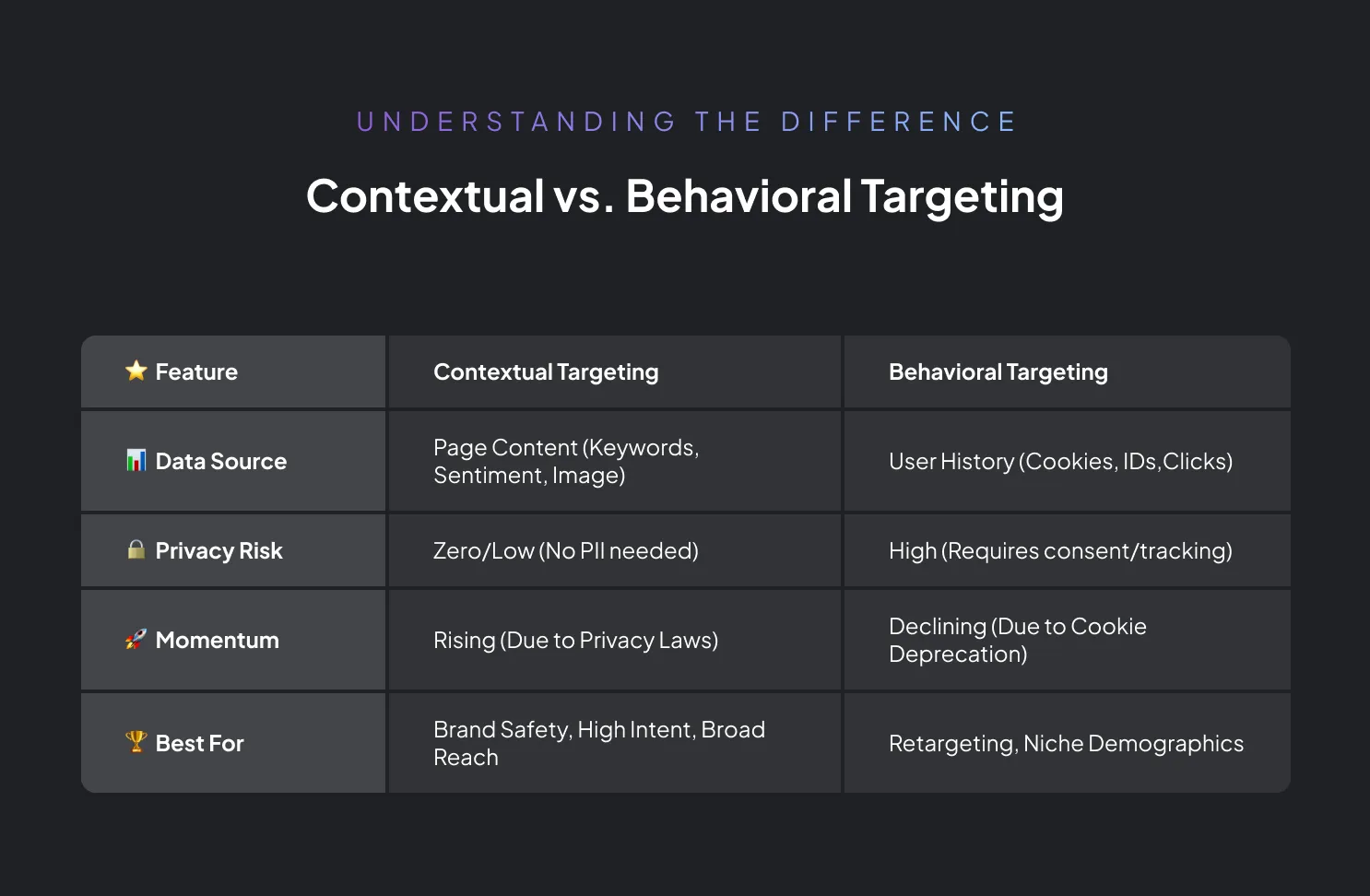
1. Contextual vs. Behavioral Targeting
- Behavioral tracks the user. It uses cookies or IDs to see that User A visited a shoe store yesterday, so it shows them a shoe ad today on a news site.
- Pro: Highly personalized based on history.
- Con: High privacy risk, relies on crumbling cookies, decreasing addressable pool
- Contextual tracks the content. It sees that a page is about "Marathon Training," so it shows a shoe ad to anyone on that page right now.
- Pro: Privacy-safe, 100% compliant, catches users in the moment of interest and higher reach regardless of country and browser.
- Con: No historical data on the specific user.
2. Contextual vs. Native Advertising This is a common mix-up. "Contextual" is the targeting method (how you decide where to show the ad). "Native" is the ad format (what the ad looks like).
The Evolution: From Keywords to Human-Level Understanding
Contextual targeting is not new, but its capabilities have changed dramatically. It’s helpful to view its history in two distinct eras:
Contextual 1.0: The Keyword Era and Basic Publisher Categorization (The Past) In the early days of programmatic, contextual targeting was rudimentary. It relied heavily on simple keyword and category matching. An advertiser might tell a demand-side platform (DSP) to target pages containing the word "jaguar.".
- The Flaw: The technology couldn't distinguish between a page about the luxury car brand Jaguar, an article about the jungle cat, or a news story about the Jacksonville Jaguars NFL team. It also struggled with safety—placing airline ads next to news stories about plane crashes simply because the keyword "flight" was present.
Contextual 2.0: The Semantic AI Era (The Present) Today, contextual targeting is powered by sophisticated artificial intelligence, including Machine Learning (ML) and Natural Language Processing (NLP).
Modern systems don't just scan for keywords; they "read" the page like a human would. They analyze:
- Semantics & Relationships: Understanding how words relate to each other within sentences and paragraphs.
- Sentiment Analysis: Determining if the tone of the content is positive, negative, or neutral.
- Image & Video Recognition: Scanning visuals frame-by-frame to understand the context of multimedia content, not just text.
This evolution means advertisers can now target the meaning of a page with incredible precision, ensuring relevance and avoiding brand-unsafe environments.
Real-World Examples of Contextual Targeting
How does this look in practice across different industries?
- The Automotive Brand: Instead of retargeting someone who looked at cars last week, a new electric vehicle brand places video ads specifically within articles reviewing "The Best Green Technologies of 2024" or YouTube videos comparing electric SUVs.
- The Financial Services Firm: A bank promoting a new high-yield savings account uses contextual AI to target pages discussing "inflation tips," "retirement planning," or "stock market trends," ensuring the user is in a financial mindset.
- The CPG Food Brand (Nuance in Action): A brand selling premium pasta sauce targets recipe sites. Crucially, advanced contextual tools ensure the ad runs on a recipe for "Authentic Italian Lasagna," but excludes pages discussing "low-carb keto diets," where the ad would be irrelevant even though it's food-related.
The Key Benefits of Contextual Targeting
Why are major brands shifting significant budgets toward contextual strategies?
1. Unrivaled Privacy Compliance This is the biggest driver. Because contextual targeting relies on page data, not user data, it completely sidesteps complex privacy regulations. You don't need consent banners to analyze the text of a webpage.
2. Capturing High Intent When a user is actively reading content about a specific topic, their intent is high. Advertising to someone while they are researching home renovations is often more effective than retargeting them three days later when they are reading news about politics.
3. Enhanced Brand Safety and Suitability Contextual 1.0 was risky. Contextual 2.0 is the ultimate safety tool. By understanding sentiment, AI can ensure your ads only appear in environments that align with your brand values, actively blocking negative adjacencies (e.g., hate speech, disasters, controversial political content).
4. Combatting Banner Blindness Ads that align visually and thematically with the content a user is consuming feel less intrusive and more like a natural part of the browsing experience, leading to better engagement rates.
5. Better Targeting Coverage: This enables targeting across a shifting ecosystem and environments with limited user data (i.e. Safari, GDPR)
The Data Behind the Shift
If you are wondering whether contextual targeting can truly compete with behavioral tracking, the data speaks for itself. Recent studies from 2024 and 2025 indicate that contextual doesn't just match behavioral performance—it often exceeds it while costing less.
1. Consumers Prefer Context Over Surveillance The most critical stat for modern brands is consumer sentiment. People are tired of being "stalked" by ads.
- 94% of consumers in the US, UK, and Canada prefer contextually relevant ads over those based on their browsing history.
- 80% of consumers say they are more likely to engage with an ad if it matches the content they are currently viewing.
- Source: GumGum 2025 Contextual Mindset Study
2. Higher Purchase Intent & Engagement Does "safe" mean "boring"? Absolutely not. Contextual alignment drives deeper focus.
- Contextually optimized ads drive 43% higher purchase intent and 2.2x higher engagement rates compared to non-contextual placements.
- Speed to Attention: It takes consumers just 0.4 seconds to notice an in-context ad, compared to 1.0 seconds for an out-of-context ad.
- Source: Integral Ad Science (IAS) The Context Effect
3. Superior Cost Efficiency (CPA & ROI) Contextual targeting often bypasses the high data costs associated with third-party audience segments.
- Contextual campaigns can generate a 48% lower Cost Per Click (CPC) than behavioral targeting.
- Recent data shows contextual AI campaigns cost up to 20% less per conversion while delivering better returns than cookie-dependent methods.
- Source: GumGum & Xapads Performance Data
4. Market Growth The industry is betting big on this technology.
- The global contextual advertising market is projected to grow at a CAGR of 13.3%, reaching new heights by 2030 as privacy laws tighten globally.
- Source: Grand View Research Market Analysis
The Future of Contextual Targeting
What’s next for this technology? The horizon is expanding beyond text-based websites into a multi-sensory, data-rich ecosystem.
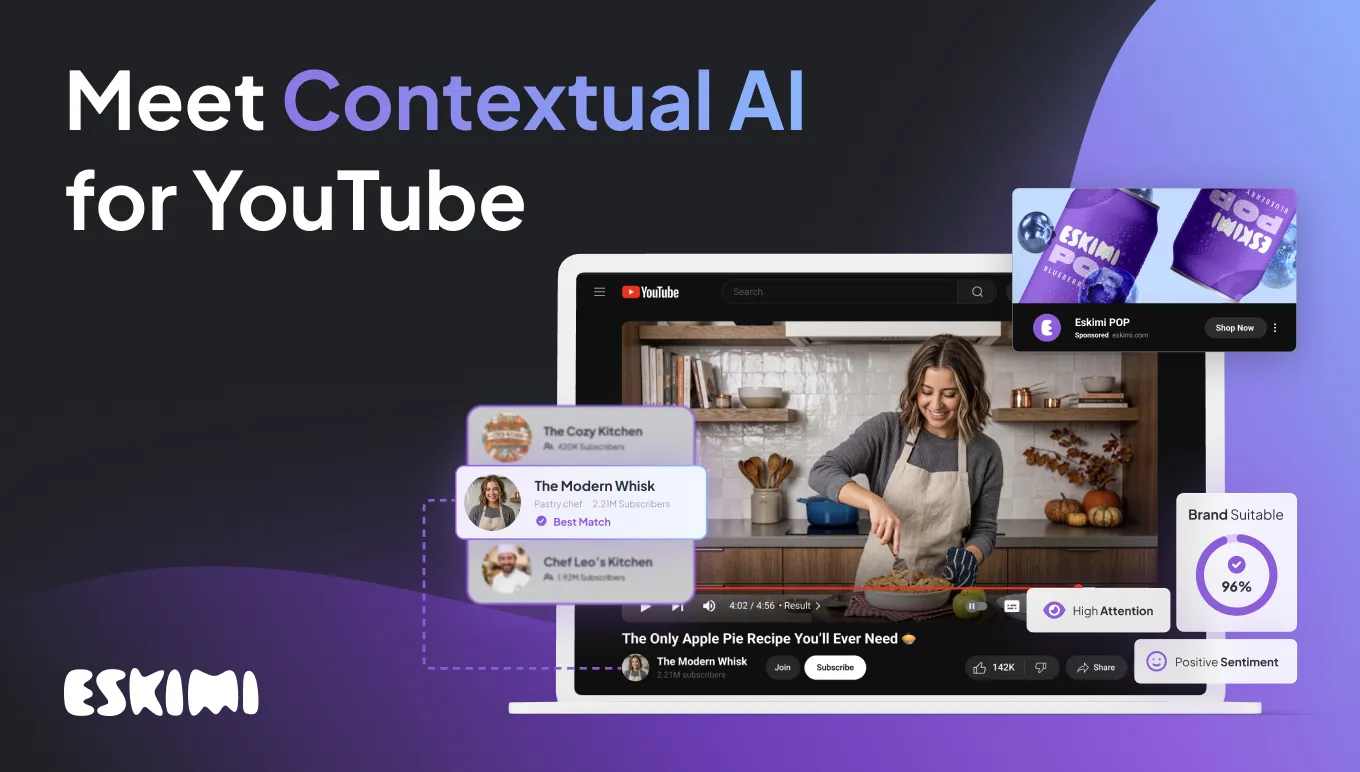
1. Contextual Video and Audio (CTV & Podcasts) This is the most explosive growth area. Standard keyword matching doesn't work for video. Instead, Computer Vision AI now analyzes the actual content of video frames frame-by-frame.
- Visual Recognition: Identifying objects (e.g., a Nike shoe), logos, and actions (e.g., a goal being scored).
- Audio Intelligence: Transcribing podcast audio in real-time to place ads within relevant conversational moments.
- Example: A sneaker brand placing an ad on a Connected TV (CTV) streaming service exactly at the moment a character in a movie starts running. A
- Example B: Don’t show a Qatar Airways ad if there is an airplane crashing in the show. Codifying the content before and after the break
2. Sentiment as a Targeting Layer Moving beyond just "topic," brands are now targeting "moods."
- Vibe Check: A travel brand might specifically target content with an "aspirational" or "joyful" sentiment score, while blocking content that is "gloomy" or "anxious"—even if the keywords are identical.
- Quote: "Looking ahead, the future may bring an even more intricate level of context to ads... Take things like weather signals. Those become context, as well." — Tony Marlow, CMO at LG Ad Solutions.
3. The "Hybrid" Strategy: Merging Contextual with First-Party Data The most powerful strategy for 2026 involves a hybrid approach.
- The Concept: Brands use their own First-Party Data (CRM, email lists) to understand who their audience is, and Contextual Targeting to find where they are engaging across the open web.
- Why it wins: It combines the precision of known customer data with the scale of the open web, without relying on third-party cookies.
4. AI-Powered Deep Analysis (Generative AI & LLMs)
While traditional NLP classifies content into broad buckets (e.g., "Sports"), the next wave uses Large Language Models (LLMs) to achieve human-level comprehension.
- From "What" to "Why": Current tools tell you a page is about Running. AI-powered analysis tells you why it matters: "This article is a motivational story about a runner overcoming injury." This distinction allows a healthcare brand to target the "overcoming injury" angle, while a shoe brand targets the "performance" angle on the same page.
- Conversational Querying: Instead of selecting from a fixed menu of 200 categories, advertisers can now use "Prompt Targeting." You can ask the AI: "Find me pages where the author feels skeptical about cryptocurrency but hopeful about blockchain technology." The AI scans the open web to find that exact, nuanced sentiment.
- Fluid Segmentation: LLMs create audience segments that adapt in real-time. If a new trend emerges (e.g., "quiet luxury"), the AI instantly understands the concept and finds relevant pages without needing a manual keyword update.
Leading Contextual Targeting Tools
To execute sophisticated contextual campaigns, you need the right technology partners. Here are some of the industry leaders shaping this space:
- Eskimi: A powerful player in the programmatic space (humble brag), Eskimi's DeepContext technology goes beyond basic keywords. It utilizes advanced AI to understand the semantic meaning and sentiment of content across numerous languages, allowing for highly granular targeting and robust brand safety profiles.
- Seedtag: Specializes in contextual advertising with a focus on visual context and creating engaging, native ad experiences that align with surrounding content.
- Iluma: Offers sophisticated contextual targeting capabilities with an emphasis on positive, brand-suitable environments rather than just brand safety avoidance.
- GumGum: A pioneer in contextual intelligence that uses computer vision and natural language processing to understand both text and visual content, enabling targeting based on the complete context of a page including images and videos.
- Integral Ad Science: A global leader in digital ad verification. IAS is renowned for its "Context Control" solutions, which provide advertisers with granular control over content suitability and brand safety, classifying billions of pages daily.
- Oracle Contextual Intelligence (formerly Grapeshot): A veteran in the space known for its speed and ability to create custom, pre-bid contextual segments that react to trending topics in real-time.
- DoubleVerify: Similar to IAS, they offer robust solutions for authenticating media quality and ensuring contextual alignment.
Strategy: What Brands Need to Consider to Succeed
Moving to a contextual-first strategy requires a shift in mindset. Here is practical guidance for brands:
- Move Beyond Keywords: If your strategy relies solely on a list of 50 keywords, you are stuck in Contextual 1.0. Adopt semantic targeting tools that understand broader topics and themes.
- Define Brand Suitability, Not Just Safety: "Safety" means avoiding illegal or horrific content. "Suitability" is nuanced. Is a news article about a mild economic downturn suitable for a luxury car brand? Define your brand's specific risk tolerance boundaries.
- Test Contextual vs. Behavioral Head-to-Head: Don't just switch overnight. Run A/B tests. Often, brands find that contextual targeting delivers a lower CPA (Cost Per Acquisition) because it reaches users higher in the funnel when they are in research mode.
- Look at the Full Page: Ensure your tool analyzes the entire page environment, including the URL, the text body, and the images, for a complete picture.
The Architect vs. The Chaser
For too long, digital advertising has been about the chase. We chased users across the web, hoarding their data, hoping to catch them at the right time, even if it meant annoying them in the wrong place.
That era is ending.
The shift to Contextual Targeting isn't a constraint; it's a liberation. It allows you to stop being the "Chaser" and start being the "Architect." You are now building environments where your brand belongs. You are aligning with culture, mood, and mindset rather than just an ID string.
The tools are ready (Eskimi, IAS, Oracle). The data is undeniable (higher intent, better privacy, lower costs). The only variable left is your strategy.
Will you cling to the dying cookie? Or will you build a strategy that respects your customer and converts them in the moment that matters most?
The future of advertising isn't just "privacy-first." It's context-first.


Level Up Your Advertising with Eskimi
- Reach 96% of Open Web
- 2,500+ Targeting Options
- 100% Managed or Self-Service
- In-House Creative Studio Team
- Display, Video, In-Game & CTV
- #1 Rated DSP on G2
Launch your next display ad campaign with us