
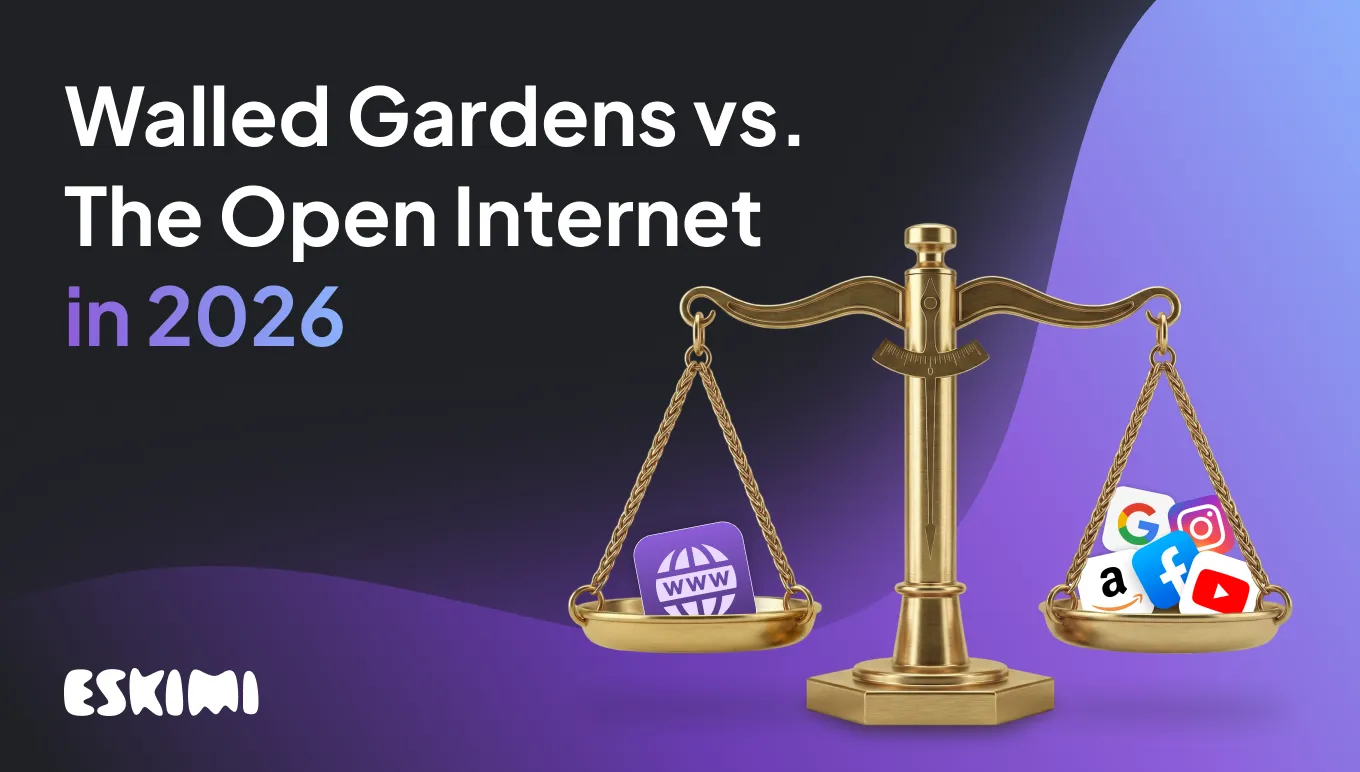
Walled Gardens vs. The Open Internet in 2026

Digital advertising has never been more concentrated.
A handful of platforms Google, Meta, TikTok, Amazon capture the majority of global ad spend. These ecosystems are known as walled gardens. They offer scale, strong targeting, and simple execution.
But outside these platforms, another massive opportunity exists.
The open internet — millions of websites, apps, streaming platforms, and gaming environments still captures a huge share of user attention.
For marketers, the question is no longer which one to choose.
The real question is:
How do you combine both to get better reach, stronger attention, and more efficient spend?
The answer is clear.
You need both.
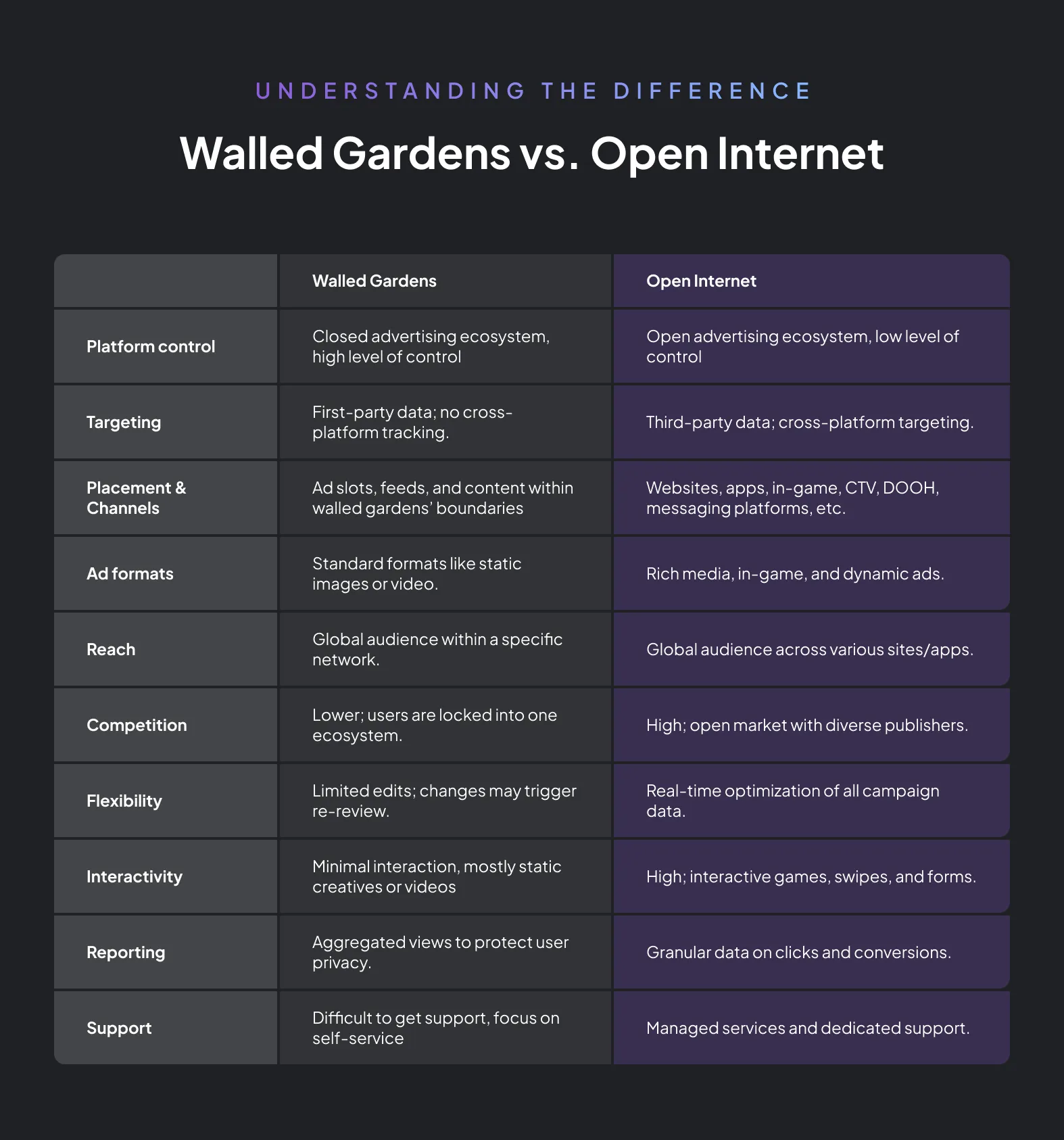
What are walled gardens (and why they dominate)
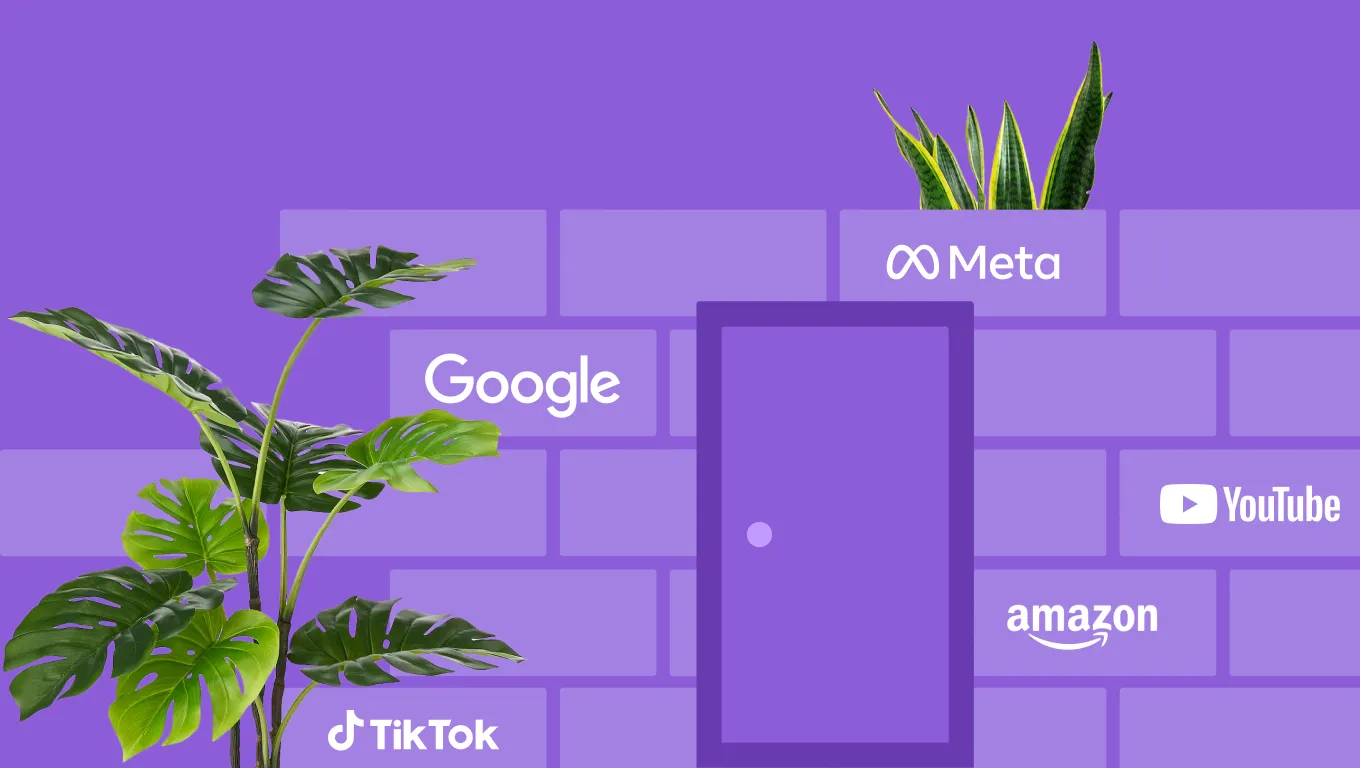
Walled gardens are closed ecosystems where platforms control:
• Audience data
• Inventory
• Targeting
• Measurement
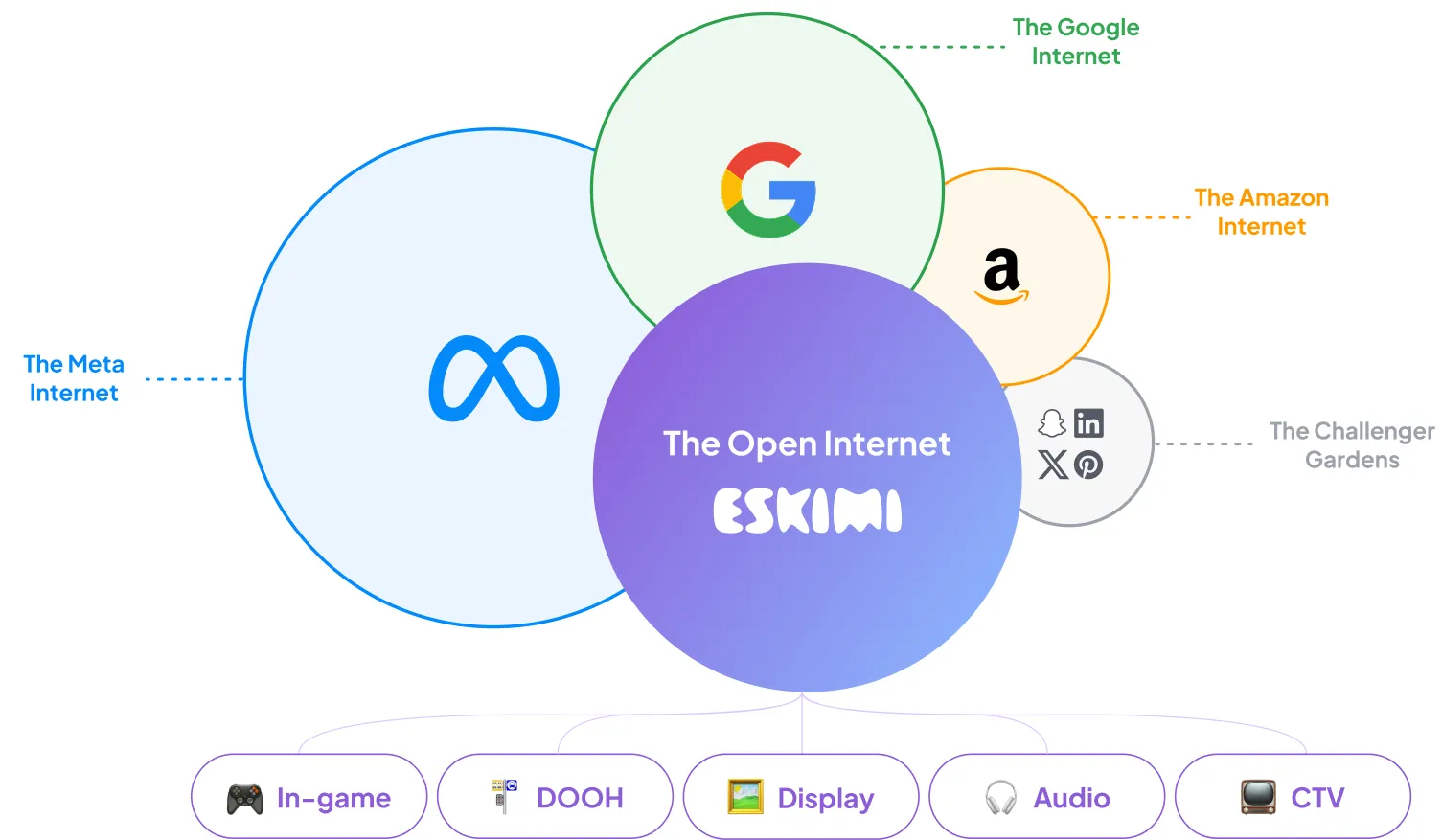
Examples include Google, YouTube, Meta, TikTok, and Amazon.
These platforms dominate for a reason.
They offer massive scale. In many markets, platforms like Meta and YouTube reach 60–80% of internet users.
They also simplify campaign execution. You can launch, optimize, and scale campaigns quickly within one environment.
This makes them highly effective for:
• Performance campaigns
• Retargeting
• Fast scaling
But there is a trade-off. You operate inside their system.
That means:
• Limited transparency
• Limited control over inventory
• Limited flexibility in creative formats
You get efficiency. But you give up control.
The open internet: scale beyond the platforms
The open internet includes everything outside walled gardens.
This means:
- Publisher websites
- Mobile apps
- Gaming environments
- Connected TV
- Digital audio
- Digital Out-Of-Home
This ecosystem is often underestimated. But it shouldn’t be.
Research from IAB and Comscore shows that around half of digital time is spent outside the largest platforms.
That’s a huge amount of attention.
Programmatic display alone can reach 50–70% of online audiences in many markets. Add mobile apps, CTV, and gaming, and that reach grows even further.
The open internet gives you access to moments that platforms can’t fully capture.
Reading. Watching. Playing. Exploring.
Different behaviors. Different mindsets.
Reach is not owned by one channel
One of the biggest mistakes in media planning is assuming one platform can deliver full coverage.
It can’t.
Different channels reach users in different ways.
- Programmatic display reaches users while they browse content.
- Social platforms reach users during discovery moments.
- Video platforms capture entertainment time.
- Audio reaches users when they are multitasking.
Each channel covers a different part of the day.
This is why combining channels increases total reach.
Relying on one ecosystem leads to overlap and wasted impressions.
Using multiple environments expands coverage and improves efficiency.
Cost efficiency requires balance
Cost is where the difference becomes clear.
Not all impressions cost the same.
Programmatic display typically operates at a baseline indicative CPM level because of high supply.
Social and video platforms often come at a premium due to demand.
Typical cost patterns look like this:
- Programmatic display: baseline (1.0)
- TikTok: around 2.0
- Meta: around 2.5–3.0
- YouTube: around 3.5
- Audio: around 3.5–4.0
- DOOH: around 4.0+
- Linear TV: up to 10x higher
This doesn’t mean expensive channels are bad.
They often deliver strong engagement.
But relying only on high-cost channels limits scale.
A balanced mix allows you to:
- Use premium channels for impact
- Use efficient channels for reach
That combination improves overall performance.
Creative flexibility is where the open internet wins
Creative is often overlooked in media planning.
But it has a direct impact on performance.
Walled gardens typically limit creative formats.
You work within predefined templates:
- Vertical video
- In-feed ads
- Pre-roll formats
These formats are optimized for the platform. But they don’t always allow creative experimentation.
The open internet offers much more flexibility.
You can run:
- Interactive rich media
- Gamified ads
- Dynamic creatives
- Contextual variations
- Augmented reality formats
These formats invite users to engage. They turn ads into experiences instead of interruptions.
That changes how users interact with the brand.
Indicative ranges based on industry benchmarks
These figures are illustrative estimates based on the author's interpretation of publicly available research and industry trends (as of 2026). They are not proprietary data. Reach and attention metrics vary meaningfully by region, audience, and campaign context , use them as a starting point, not a source of truth.
Context drives attention
Attention is becoming one of the most important metrics in advertising.
Because not all impressions are equal.
Research from Dentsu shows that ads with higher attention are 2.6 times more likely to drive brand impact.
This changes how we think about media.
It’s not just about delivering impressions. It’s about delivering meaningful exposure.
Context plays a big role here.
When ads appear in relevant environments, they feel more natural.
For example:
A travel ad in a destination guide.
A fitness product in a workout article.
A finance service in an investment piece.
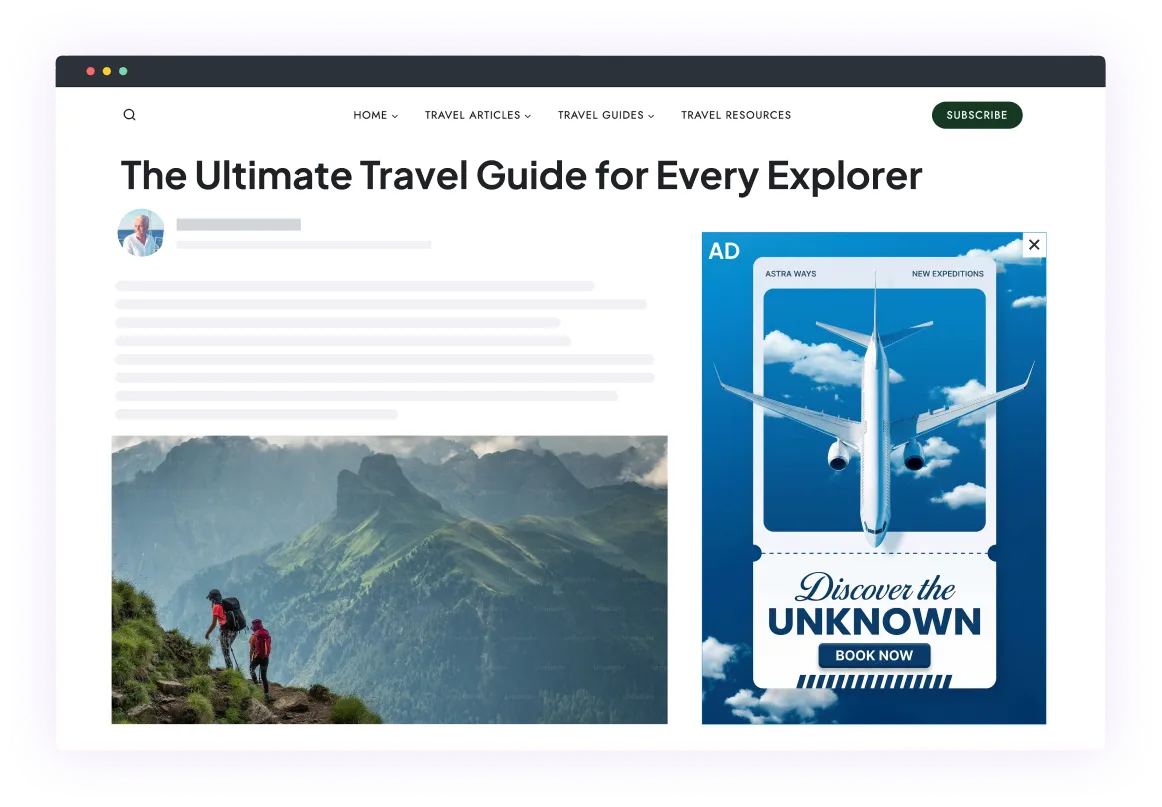
This relevance increases engagement.
Research from GumGum shows that contextually relevant ads drive 63% higher purchase intent. Similar numbers on we at Eskimi see with DeepContext.
That’s a major difference.
When it comes to Attention there’s also a big difference between the different channels. A study conducted by Lumen Research shows, a substantial difference on walled vs. open internet.
Measurement and transparency matter
Another key difference between ecosystems is measurement.
Walled gardens provide strong internal reporting.
But they often limit access to raw data.
You rely on the platform’s own measurement framework.
The open internet allows independent measurement.
You can use third-party tools to track:
- Viewability
- Attention
- Brand safety
- Engagement
This creates a more complete picture.
It also enables better media mix modeling.
Media mix modeling helps you understand how each channel contributes to results.
Without it, you risk over-investing in one platform simply because it reports better results.
Incrementality is where the open internet adds value
One of the most important concepts in modern media planning is incrementality.
It answers a simple question: Are you reaching new people, or the same people again?
Walled gardens are strong at targeting. But they often reach the same users multiple times.
The open internet expands your reach. It introduces your brand to new audiences in different environments.
This improves:
- Total reach
- Frequency balance
- Campaign effectiveness
Studies in media mix modeling consistently show that adding open web channels increases overall campaign performance.
Not because they replace platforms.
But because they complement them.
Why the best strategy is a blended media mix
This is where everything comes together.
Walled gardens are powerful. They offer scale, targeting, and efficiency.
The open internet offers flexibility, diversity, and incremental reach.
Each solves a different problem. The most effective strategy combines both.
A strong media mix typically includes:
- Walled gardens - For scale, performance, and optimization
- Open internet - For reach extension, contextual relevance, and creative impact
This approach avoids over-reliance on a single ecosystem.
It also improves long-term performance.

The risk of over-relying on walled gardens
It’s easy to concentrate spend where results are easiest to measure.
But this creates risk.
Over-investing in walled gardens can lead to:
- Audience saturation
- Rising costs
- Limited creative differentiation
- Reduced incremental reach
It also limits your ability to experiment.
The open internet provides that flexibility. It allows you to test new formats, new environments, and new strategies.
That’s critical for long-term growth.
The future of media planning
The industry is shifting.
Privacy changes are reducing reliance on identity-based targeting. Attention metrics are becoming more important. Contextual advertising is becoming more advanced.
In this environment, flexibility matters.
The brands that succeed will:
- Diversify their media mix
- Focus on attention, not just impressions
- Invest in creative formats
- Use contextual signals to stay relevant
Most importantly, they will avoid choosing one ecosystem over another.
The takeaway
Walled gardens are not going away. Neither is the open internet. Both play a critical role in modern advertising.
The difference is how you use them.
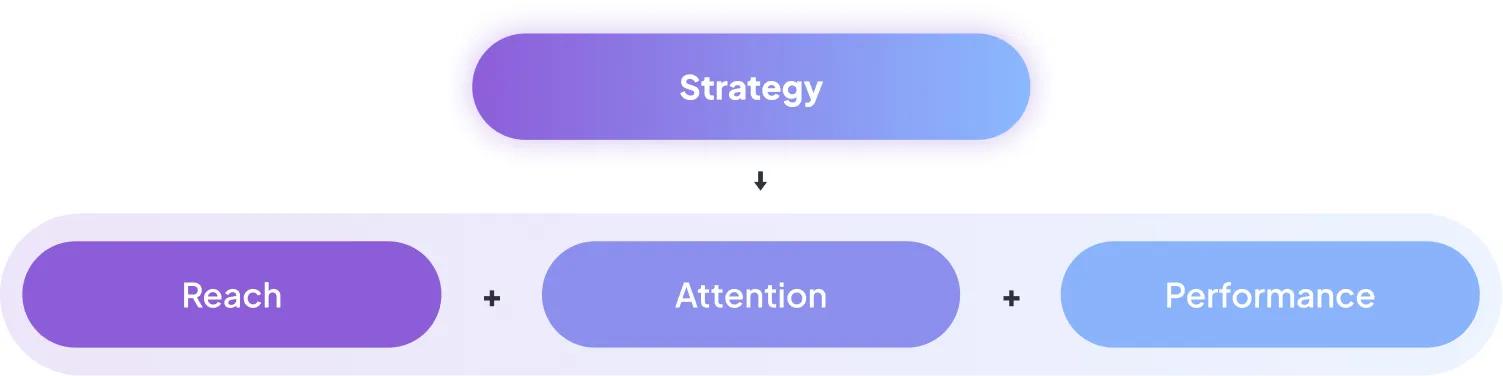
If you want:
- More reach
- Better attention
- Stronger performance
You need a strategy that combines both.Not as separate channels.
But as part of one connected system for impact.


Level Up Your Advertising with Eskimi
- Reach 96% of Open Web
- 2,500+ Targeting Options
- 100% Managed or Self-Service
- In-House Creative Studio Team
- Display, Video, In-Game & CTV
- #1 Rated DSP on G2
Launch your next display ad campaign with us